
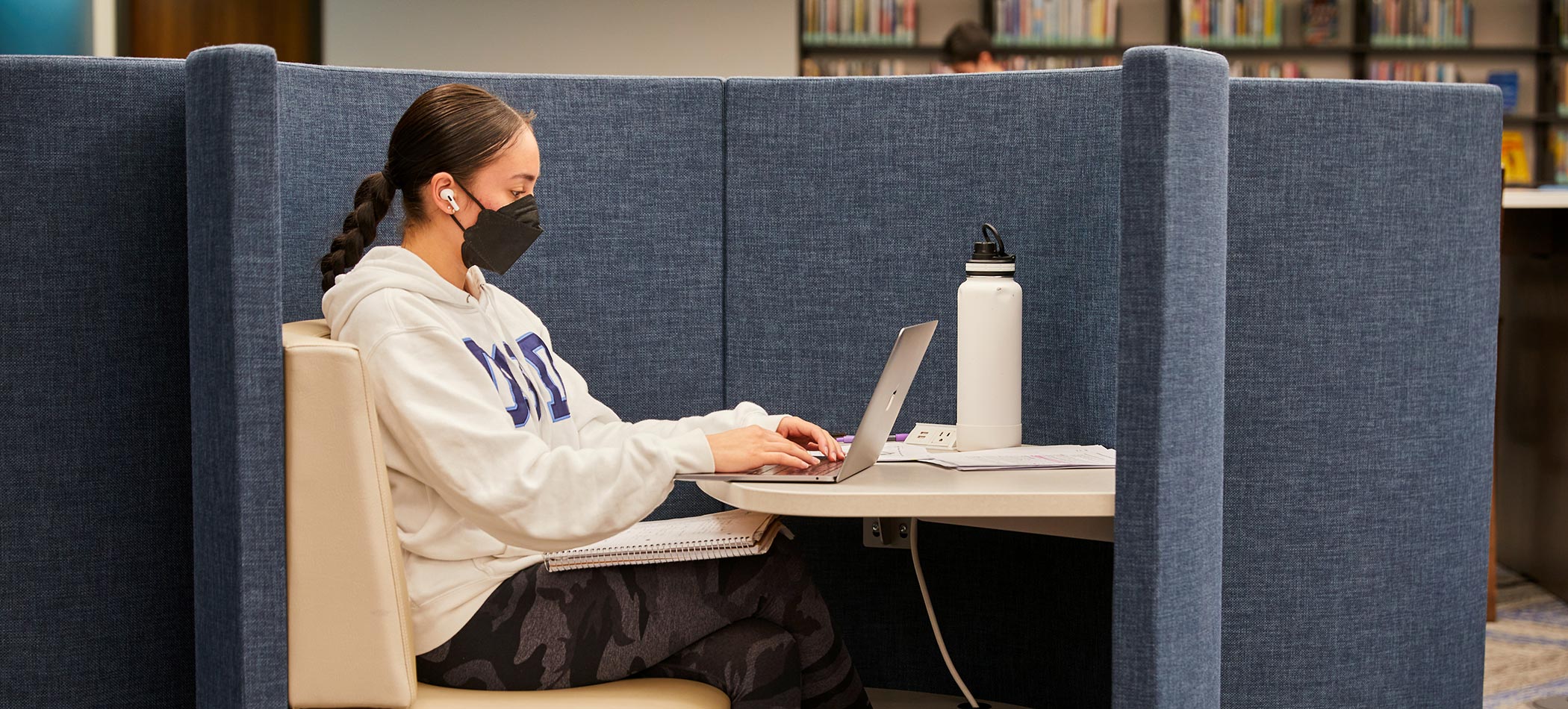
Copley Library supports teaching, research and study at the University of San Diego as its primary mission through its collections, services and spaces. The library has developed policies to create an atmosphere conducive to this mission and encourages all users to adhere to these policies in support of this mission. These policies include information about borrowing books and other materials from the library along with loan terms for borrowing and any fines for late returns. The library reserves the right to refuse access, collections, and services to any user not behaving in accordance with these policies.
Borrowing Policies
Borrowing Policies – General Policies and Loan Terms for USD Students
Copley Library, the Legal Research Center, Media Services, the Art Department, and SOLES have different policies regarding loan periods and fines. This document defines the policy for Copley Library materials only.
Copley Library’s mission is to serve each user by making materials available when they are needed. We ask that you do your part to assure continued timely service to all by returning borrowed materials promptly within the stated loan periods. These guidelines were developed to inform you of Copley Library Borrowing Privileges and Fines Policy.
For assistance call or email:
Access and Outreach Supervisor Desk (619) 260-4799 or claccess@sandiego.edu.
Request It:
Patrons may request that library materials be retrieved from the stacks or from offsite storage and held at Copley Library’s Access Services Desk for pickup. To request a hold, find the item in the online catalog and click the “Request it” button. Requests placed before 11am will be available for pick up the next business day. Request made after 11am will be available in two business days (weekends and holidays not included). You will be notified via email when your request is available for pickup at the Access Services Desk. You have seven days to pick up your request. After that, the materials will be returned to their location or circulate to the next patron.
Undergraduate Loan Periods, Fees, and Renewals Table
Graduate / Doctoral Student Loan Periods, Fees, and Renewals Table
Renewals:
Students are allowed to renew or extend the period of time for which materials are loaned by the length of the normal loan period. Renewal policies vary depending on the material format (see link to Loan Periods Table above). To avoid fines, items checked out must be renewed by the borrower on or before the due date. In most cases you are sent a reminder notice shortly before the due date reminding you that your materials are coming due (see Library Due Date Notices below).
Library Due Date Notices:
- Reminder Notice A Reminder Notice is sent shortly before the item is due to remind you to either return or renew it. Reminder Notices are not sent for reserve items that have an hourly loan period.
- First Overdue Notice One day after the item is due, a First Overdue Notice is sent. This indicates that late fees are being assessed.
- Second Overdue Notice If the item is not returned, a Second Overdue Notice is sent. This indicates that late fees continue to accrue and warns that you may be billed for the item if it is not returned.
- Billing Notice If the item becomes long overdue, a Billing Notice is sent. The Notice includes the replacement cost of the item plus a non-refundable service fee. Borrowing privileges may be suspended. Failure to respond to a billing notice will result in your account being sent to the Student Accounts Office.
- Recall Notice Copley Library occasionally recalls an item by requesting a borrower to return it at the end of its current loan period. A recalled item cannot be renewed. A Recall Notice is sent to your email address. If you do not respond or return the item by the due date assigned in the Recall Notice, fines will be assessed from the recalled due date, not the original due date. At least one full loan period for each item is guaranteed.
Replacement Costs:
Materials not returned to Copley Library are billed at a default replacement cost plus a service charge listed in the table below. Replacement fees are set at a minimum default cost which means we reserve the right to charge more if actual replacement cost exceeds the default amount. Replacement fees are never reduced even if the cost to replace the item is less than the default cost. Patrons can get the replacement cost refunded if the material is returned and the fines assistant is notified but will still be charged a $45 service fee. Borrowing privileges are suspended once a student accumulates $50 in fines.
Pay Fines
Library fines may be paid in person at Copley Library via cash, check or campus cash. Fines totaling five dollars or more are transferred to Student Financial Services during the first week of each month. If your fines total five dollars or more, you may wait until they are transferred and pay online via Student Financial Services webpage.
Electronic Resources Access:
Currently enrolled students can access electronic resources (databases, e-books, etc.) on and off campus.
Library E-mail Addresses:
Your University of San Diego email address (“@sandiego.edu”) is your official university business email and all library correspondence is sent to it. The library is not responsible for email not received or sent to an old address. You are responsible for checking your university email and notifying the library of any changes or discrepancies. To check what e-mail address is currently on your library record, log in to your library account.
If you wish to “forward” your email from your USD email address to a different email address, contact the Help Desk at (619) 260-7900.
Effective September 2024
Borrowing Policies – General Policies and Loan Terms for USD Faculty and Staff
Copley Library, the Legal Research Center, Media Services, the Art Department, and SOLES have different policies regarding loan periods and fines. This document defines the policy for Copley Library materials only.
Copley Library’s mission is to serve each user by making materials available when they are needed. We ask that you do your part to assure continued timely service to all by returning borrowed materials promptly within the stated loan periods. These guidelines were developed to inform you of Copley Library Borrowing Privileges and Fines Policy.
For assistance call or email:
Access and Outreach Supervisor Desk (619) 260-4799 or claccess@sandiego.edu.
Research/Graduate Assistant Proxy Form
If faculty members wish to have their research assistant pick up their materials, they will need to complete our research/graduate assistant proxy form.
Request It:
Patrons may request that library materials be retrieved from the stacks or from offsite storage and held at Copley Library’s Access Services Desk for pickup. To request a hold, find the item in the online catalog and click the “Request it” button. Requests placed before 11am will be available for pick up the next business day. Request made after 11am will be available in two business days (weekends and holidays not included). You will be notified via email when your request is available for pickup at the Access Services Desk. You have seven days to pick up your request. After that, the materials will be returned to their location or circulate to the next patron.
Faculty / Staff Loan Periods and Renewals Table
Renewals Policy:
Faculty and Staff are allowed to renew or extend the period of time for which materials are loaned by the length of the normal loan period. Renewal policies vary depending on the material format (see link to Loan Periods Table above). Please renew on or before the due date. In most cases you are sent a reminder notice shortly before the due date reminding you that your materials are coming due (see Library Due Date Notices below).
Library Due Date Notices:
- Reminder Notice A Reminder Notice is sent shortly before the item is due to remind you to either return or renew it. Reminder Notices are not sent for reserve items that have an hourly loan period.
- First Overdue Notice One day after the item is due, a First Overdue Notice is sent. This indicates that late fees are being assessed.
- Second Overdue Notice If the item is not returned, a Second Overdue Notice is sent. This indicates that late fees continue to accrue and warns that you may be billed for the item if it is not returned.
- Third Overdue Notice If the item is not returned, a Third Overdue Notice is sent. This indicates that late fees continue to accrue and warns that you may be billed for the item if it is not returned.
- Fourth Overdue Notice If the item is not returned, a Fourth and Final Overdue Notice is sent. This indicates that late fees continue to accrue and warns that you may be billed for the item if it is not returned.
- Recall Notice Copley Library occasionally recalls an item by requesting a borrower to return it at the end of its current loan period. A recalled item cannot be renewed. A Recall Notice is sent to your email address. If you do not respond or return the item by the due date assigned in the Recall Notice, fines will be assessed from the recalled due date, not the original due date. At least one full loan period for each item is always guaranteed.
San Diego Circuit Access:
San Diego Circuit Access is temporarily suspended. Current Faculty and Staff can still borrow materials from other libraries. Visit our Interlibrary Loan LibGuide for more information.
Electronic Resources Access:
Current Faculty and Staff can access electronic resources (databases, ebooks, etc.) on and off campus.
Library E-mail Addresses:
Your University of San Diego email address (“@sandiego.edu”) is your official university business email and all library correspondence is sent to it. The library is not responsible for email not received or sent to an old address. You are responsible for checking your university email and notifying the library of any changes or discrepancies. To check what e-mail address is currently on your library record, log in to your library account.
If you wish to “forward” your email from your USD email address to a different email address, contact the ITS Help Desk at (619) 260-7900.
Effective September 2024
Copley Library, the Legal Research Center, Media Services, the Art Department, and SOLES have different policies regarding loan periods and fines. This document defines the policy for Copley Library materials only.
Copley Library’s mission is to serve each user by making materials available when they are needed. We ask that you do your part to assure continued timely service to all by returning borrowed materials promptly within the stated loan periods. These guidelines were developed to inform you of Copley Library Borrowing Privileges and Fines Policy.
For assistance call or email:
Access and Outreach Supervisor Desk (619) 260-4799 or claccess@sandiego.edu.
Renewals:
Alumni are allowed to renew or extend the period of time for which materials are loaned by the length of the normal loan period. Renewal policies vary depending on the material format (see chart below). To avoid fines, items checked out must be renewed by the borrower on or before the due date. In most cases you are sent a reminder notice shortly before the due date reminding you that your materials are coming due (see Library Notices below).
Request It:
Patrons may request that library materials be retrieved from the stacks or from offsite storage and held at Copley Library’s Access Services Desk for pickup. To request a hold, find the item in the online catalog and click the “Request it” button. Requests placed before 11am will be available for pick up the next business day. Request made after 11am will be available in two business days (weekends and holidays not included). You will be notified via email when your request is available for pickup at the Access Services Desk. You have seven days to pick up your request. After that, the materials will be returned to their location or circulate to the next patron.
Replacement Costs:
Materials not returned to Copley Library are billed at a default replacement cost plus a service charge listed in the table below. Replacement fees are set at a minimum default cost which means we reserve the right to charge more if the actual replacement cost exceeds the default amount. Replacement fees are never reduced even if the cost to replace the item is less than the default cost. Patrons can get the replacement cost refunded if the material is returned and the fines assistant is notified but will still be charged a $45 service fee. Borrowing privileges are suspended once an alumni accumulates $50 in fines.
Maximum Limits:
Alumni are limited to checking out a maximum of 5 items at any given time.
San Diego Circuit Access:
Alumni do not have access to the Circuit through Copley Library.
Electronic Resources Access:
Alumni are only able to access electronic resources (databases, e-books, etc.) from on campus. Note: USD alumni now have access to the JSTOR and Business Source Premier Alumni Edition databases by going to the USD Alumni Association website and entering their alumni login.
Circulating Materials:
Alumni Loan Policy – Circulating Materials
| Format | Loan Period | No. of Renewals | Overdue Charge Per Day | Default Replacement Cost | Service Charge |
| Book/Music Score | 28 Days | 2 | $1.00 | $180.00 | $45.00 |
| Popular Books print book | 28 Days | 0 | $1.00 | $45.00 | $45.00 |
Reserve Materials:
Formats listed below are on reserve and restricted to library use only and may only be checked out by special arrangement. Fines are higher to encourage prompt return.
Alumni Loan Policy – Reserve Materials
| Format | Overdue Charge Per Hour/Day | Default Replacement Cost | Service Charge |
| Hourly Reserve | $1.00/hour | $180.00 | $45.00 |
| Daily Reserve | $20.00/day | $180.00 | $45.00 |
Library Notices:
- Reminder Notice A Reminder Notice is sent shortly before the item is due to remind you to either return or renew it. Reminder Notices are not sent for reserve items that have an hourly loan period.
- First Overdue Notice One day after the item is due, a First Overdue Notice is sent. This indicates that late fees are being assessed.
- Second Overdue Notice If the item is not returned, a Second Overdue Notice is sent. This indicates that late fees continue to accrue and warns that you may be billed for the item if it is not returned.
- Billing Notice If the item becomes long overdue, a Billing Notice is sent. The Notice includes the replacement cost of the item plus a non-refundable service fee. Borrowing privileges may be suspended.
- Recall Notice Copley Library occasionally recalls an item by requesting a borrower to return it at the end of its current loan period. A recalled item cannot be renewed. A Recall Notice is sent to your email address. If you do not respond or return the item by the due date assigned in the Recall Notice, fines will be assessed from the recalled due date, not the original due date. At least one full loan period for each item is always guaranteed.
Library E-mail Addresses:
You are responsible for providing the library your current email address. All library correspondence is sent to the address on your library record. The library is not responsible for email not received or sent to an old address. You are responsible for checking your email and notifying the library of any changes or discrepancies. To check what e-mail address is currently on your library record, log in to your library account.
Effective September 2024
Copley Library strives to serve each user by making materials available when they are needed. We ask that you do your part to assure continued timely service to all by returning borrowed materials promptly within the stated loan periods. These guidelines were developed to inform you of the Visiting Scholars Borrowing Privileges and Fines Policy for Copley Library circulating materials.
For assistance call or email:
Access and Outreach Supervisor Desk (619) 260-4799 or claccess@sandiego.edu.
Eligibility:
Visiting Scholars of the University of San Diego (USD) are scholars who have been invited to participate in on-campus research or instructional activities through sponsorship by a USD department or office.
Requirements:
- Applications for a USD Copley Library Visiting Scholar Card are available at the Access Services Desk of Copley Library or online.
- Return the completed application form, including signatures by the sponsoring Dean or Department Chair and/or any related sponsoring letter, to the Copley Library Access Services Desk.
- Show a valid ID (current driver’s license or passport) in person when submitting the application form to Copley Library staff.
- All Copley Library correspondence will be sent to the email address you provide on the application for your USD Visiting Scholar Card.
- The effective dates of coverage of a USD Visiting Scholar Card is determined and authorized by the Dean of the University Library.
- The Visiting Scholar is responsible for returning circulating materials on or before their due dates and making payment for any incurred fees.
- The sponsoring department is responsible for any outstanding fees or fines that the Visiting Scholar does not pay.
- The USD Visiting Scholar Card grants eligibility for the services specified below. If abused, privileges will be revoked.
- The library’s Visiting Scholar application approval process may take 3 to 5 business days.
Library Access:
- Onsite access to Copley Library databases, electronic resources and e-books using the library computers
- Licensing contracts for most Copley Library databases, electronic resources and e-books allow strictly onsite access to these materials for Visiting Scholars, using these resources through library computers. The library is prohibited contractually from providing other forms of onsite or remote access to Visiting Scholars for most subscribed electronic resources.
- Full use of printed materials (not on reserves) in the open book stacks is available to Visiting Scholars while in the library building.
- Ability to request circulating library materials to be retrieved from the stacks or from offsite storage and held at Copley Library’s Access Services Desk for pickup. To request a hold, find the item in the online catalog and click the “Request it” button. Requests placed before 11am will be available for pick up the next business day. Request made after 11am will be available in two business days (weekends and holidays not included). You will be notified via email when your request is available for pickup at the Access Services Desk. You have seven days to pick up your request. After that, the materials will be returned to their location or circulate to the next patron.
- Ability to print using USD’s cloud based wireless printing system WEPA.
- Ability to scan documents to email at no cost using Copley Library scanner.
- No access to Circuit or ILL services are available to Visiting Scholars unless otherwise approved by the Dean of the University Library.
- Borrowing privileges for books and audiovisual materials are specified below.
- Maximum loan of 10 items are allowed at any given time. Among these items, a limit to a total of 4 items in any of the following formats or combination thereof: DVD, VHS, CD.
- Restricted circulating materials are for library-use only except for prior special arrangement approved by the Dean of the University Library.
- Other library items not listed here are subject to a case-by-case approval.
Visiting Scholar Loan Policy – Circulating Materials
| Format | Loan Period | No. of Renewals | Overdue Charge | Default Replacement Cost | ServiceCharge |
|---|---|---|---|---|---|
| Book/CD/Music Score | 28 Days | 2 | $1.00/day | $180.00 | $45.00 |
| DVD/VHS | 3 Days | 2 | $3.00/day | $180.00 | $45.00 |
| Head Phones | Close of Library | 0 | $5.00/hour | Individual Item Replacement Cost | $15.00 |
Effective September 2024
Copley Library strives to serve each user by making materials available when they are needed. We ask that you do your part to assure continued timely service to all by returning borrowed materials promptly within the stated loan periods. These guidelines were developed to inform you of the Retired Faculty/Staff Borrowing Privileges and Fines Policy for Copley Library circulating materials.
For assistance call or email:
Access and Outreach Supervisor Desk (619) 260-4799 or claccess@sandiego.edu.
Eligibility:
Be fully retired Faculty/Staff of the University of San Diego (USD).
Requirements:
- A valid USD Copley Library Retired Faculty/Staff ID Card. ID cards are available at the One Card Office.
- Return the completed application form, to the Copley Library Access Services Desk.
- Show a valid ID (current driver’s license or passport) in person when submitting the application form to Copley Library staff.
- All Copley Library correspondence will be sent to the email address you provide on the application for your USD Retired Faculty/Staff Card.
- The USD Retired Faculty/Staff is responsible for returning circulating materials on or before their due dates and making payment for any incurred fees.
- The USD Retired Faculty/Staff Card grants eligibility for the services specified below. If abused, privileges may be revoked.
Library Access:
- Onsite access to Copley Library databases, electronic resources and e-books using the library computers.
- Licensing contracts for most Copley Library databases, electronic resources and e-books allow strictly onsite access to these materials for USD Retired Faculty/Staff, using these resources through library computers. The library is prohibited contractually from providing other forms of onsite or remote access to USD Retired Faculty/Staff for most subscribed electronic resources.
- Full use of printed materials (not on reserves) in the open book stacks is available to USD Retired Faculty/Staff while in the library building.
- Ability to request circulating library materials to be retrieved from the stacks or from offsite storage and held at Copley Library’s Access Services Desk for pickup. To request a hold, find the item in the online catalog and click the “Request it” button. Requests placed before 11am will be available for pick up the next business day. Request made after 11am will be available in two business days (weekends and holidays not included). You will be notified via email,when your request is available for pickup at the Access Services Desk. So, please make sure you the email you supply on your application is an email address that you check on a regular basis. You have seven days to pick up your request. After that, the materials will be returned to their location or circulate to the next patron.
- Limited use of Copley’s Interlibrary Loan Service. Contact ILL at clill@sandiego.edu to create your retired faculty ILL account.
- Ability to print using USD’s cloud based wireless printing system WEPA.
- Ability to scan documents to email at no cost using Copley Library scanner.
- Borrowing privileges for books and audiovisual materials are specified below.
- Maximum loan of 10 items is allowed at any given time. Among these items, a limit of 4 items in any of the following formats or combination thereof: DVD, VHS, CD.
- Other library items not listed here are subject to a case-by-case approval.
San Diego Circuit Access:
Current Faculty and Staff can borrow up to 20 items. Retired Faculty and Staff do not have access to the Circuit through Copley Library.
Annual Account Renewal
Retired faculty accounts expire each year on September 30th. Please contact us via email at claccess@sandiego.edu to request renewal of your account.
Retired Faculty/Staff Loan Policy – Circulating Materials
| Format | Loan Period | No. of Renewals | Overdue Charge | Default Replacement Cost | ServiceCharge |
|---|---|---|---|---|---|
| Book/CD/Music Score | 28 Days | 2 | $1.00/day | $180.00 | $45.00 |
| DVD/VHS | 7 Days | 2 | $1.00/day | $180.00 | $45.00 |
| Serials (Bound and Unbound) | 7 Days | 1 | $1.00/day | $1000.00 | $45.00 |
Effective September 2024
Copley Library strives to serve each user by making materials available when they are needed. We ask that you do your part to assure continued timely service to all by returning borrowed materials promptly within the stated loan periods. These guidelines were developed to inform you of the Emeritus Borrowing Privileges and Fines Policy for Copley Library circulating materials.
For assistance call or email:
Access and Outreach Supervisor Desk (619) 260-4799 or claccess@sandiego.edu.
Eligibility:
Have Emeritus status at the University of San Diego (USD).
Requirements:
- A valid USD Retired Faculty/Staff ID Card. ID cards are available at the One Card Office. If an ID is not issued for your status the library will issue an temporary paper ID card.
- Return the completed application form, to the Copley Library Access Services Desk or email it to clcirc@sandiego.edu for processing before picking up your temporary Library card if applicable.
- Show a valid ID (current driver’s license or passport) in person when submitting the application form or when picking up a temporary library card to Copley Library staff.
- All Copley Library correspondence will be sent to the email address you provide on the application for your USD Emeritus Library Card.
- The Emeritus faculty member is responsible for returning circulating materials on or before their due dates and making payment for any incurred fees.
- The USD Emeritus Library Card grants eligibility for the services specified below. If abused, privileges may be revoked.
Library Access:
- Remote access to most Copley Library databases, electronic resources and e-books.
- Full use of printed materials (not on reserves) in the open book stacks is available to USD Emeritus while in the library building.
- Ability to request circulating library materials to be retrieved from the stacks or from offsite storage and held at Copley Library’s Access Services Desk for pickup. To request a hold, find the item in the online catalog and click the “Request it” button. Requests placed before 11am will be available for pick up the next business day. Requests made after 11am will be available in two business days (weekends and holidays not included). You will be notified via email,when your request is available for pickup at the Access Services Desk. So, please make sure the email you supply on your application is an email address that you check on a regular basis. You have seven days to pick up your request. After that, the materials will be returned to their location or circulate to the next patron.
- Limited use of Copley’s Interlibrary Loan Service. Contact ILL at clill@sandiego.edu to create your Emeritus ILL account.
- Ability to print using USD’s cloud based wireless printing system WEPA.
- Ability to scan documents to email at no cost using Copley Library scanner.
- Borrowing privileges for books and audiovisual materials are specified below.
- Maximum loan of 10 items is allowed at any given time. Among these items, a limit of 4 items in any of the following formats or combination thereof: DVD, VHS, CD.
- Other library items not listed here are subject to a case-by-case approval.
Account Renewal
USD Emeritus accounts expire each year on September 30th. Please contact us via email at claccess@sandiego.edu to request renewal of your account.
USD Emeritus Faculty Loan Policy – Circulating Materials
| Format | Loan Period | No. of Renewals | Overdue Charge | Default Replacement Cost | ServiceCharge |
|---|---|---|---|---|---|
| Book/CD/Music Score | 28 Days | 2 | $1.00/day | $180.00 | $45.00 |
| DVD/VHS | 7 Days | 2 | $1.00/day | $180.00 | $45.00 |
| Serials (Bound and Unbound) | 7 Days | 2 | $1.00/day | $1000.00 | $45.00 |
|
Popular Books print book |
28 Days | 0 | $1.00/day | $45.00 | $45.00 |
| Circuit Book | 112 Days | 0 | $1.00/day | $100 + $25 processing fee | $15.00 |
Effective September 2024
For Information on applying to become a USD Research Associate, please visit the Provost Office USD Research Associate webpage at: https://www.sandiego.edu/provost/research/research-associate.php.
Inquiries regarding Research Associate status should be directed to the Provost Office.
Copley Library strives to serve each user by making materials available when they are needed. We ask that you do your part to assure continued timely service to all by returning borrowed materials promptly within the stated loan periods. These guidelines were developed to inform you of the USD Research Associate Borrowing Privileges and Fines Policy for Copley Library circulating materials.
For assistance regarding your library account call or email:
Access and Outreach Supervisor Desk (619) 260-4799 or claccess@sandiego.edu.
Eligibility:
Research Associates of the University of San Diego (USD) must apply and be selected for this temporary position by the Provost Office.
Requirements:
- Be appointed as a Research Associate at USD. For Information on applying to become a USD Research Associate, please visit the Provost Office webpage at: https://www.sandiego.edu/provost/research/research-associate.php.
Library Access:
- Remote access to Copley Library databases and electronic resources including e-books.
- Ability to request circulating library materials to be retrieved from the stacks or from offsite storage and held at Copley Library’s Access Services Desk for pickup. To request a hold, find the item in the online catalog and click the “Request it” button. Requests placed before 11am will be available for pick up the next business day. Requests made after 11am will be available in two business days (weekends and holidays not included). You will be notified via email when your request is available for pickup at the Access Services Desk. You have seven days to pick up your request. After that, the materials will be returned to their location or circulate to the next patron.
- Ability to print using USD’s cloud based wireless printing system WEPA.
- Ability to scan documents to email at no cost using Copley Library scanner.
- No access to Circuit or ILL services are available to Research Associates unless otherwise approved by the Dean of the University Library.
- Borrowing privileges for books and audiovisual materials are specified below.
- Maximum loan of 10 items are allowed at any given time. Among these items, a limit to a total of 4 items in any of the following formats or combination thereof: DVD, VHS, CD.
- Restricted circulating materials are for library-use only except for prior special arrangement approved by the Dean of the University Library.
- Other library items not listed here are subject to a case-by-case approval.
USD Research Associate Loan Policy – Circulating Materials
| Format | Loan Period | No. of Renewals | Overdue Charge | Default Replacement Cost | ServiceCharge |
|---|---|---|---|---|---|
| Book/CD/Music Score | 28 Days | 2 | $1.00/day | $180.00 | $45.00 |
| DVD/VHS | 3 Days | 2 | $3.00/day | $180.00 | $45.00 |
| Headphones | Close of Library | 0 | $5.00/hour | Individual Item Replacement Cost | $15.00 |
Effective September 2024
General Policies
I. Introduction & Mission
Copley Library supports the University of San Diego’s (USD) academic mission, vision, and values by curating comprehensive print and digital collections. Through expert subject specialist oversight, strategic purchasing and licensing, and advanced discovery platforms, the library acquires and maintains resources that support faculty, undergraduate, graduate, and doctoral research and curricular use at USD.
II. Intellectual Freedom, Catholic Intellectual Tradition & Inclusive Representation
The library adheres to the American Library Association’s Intellectual Freedom statement and the University faculty policy on Academic Freedom Policy 4.1.
- Balanced Perspectives: Copley Library provides the university community with a collection that represents a broad range of viewpoints, including those that are controversial or challenging, particularly in areas of academic, cultural, and social controversy.
- Catholic Intellectual Tradition: Reflecting the Catholic intellectual tradition, Copley Library values existing scholarship as the bedrock of new discovery, curating the collection to ensure that the wisdom of the past is preserved, shared, and adapted—never hidden—to inspire future learning and evolution.
- Inclusive Representation: Acknowledging historical gaps in scholarly representation, the library actively seeks materials from underrepresented communities.
III. Selection Practices & Responsibilities
Collection development is led by Copley librarians as subject specialists assigned to the College of Arts and Sciences and Joan B. Kroc School of Peace Studies or embedded within USD’s other Academic Units (Knauss School of Business, Shiley-Marcos School of Engineering, Hahn School of Nursing and Health Science, School of Leadership and Education Sciences).
- Funding Requirements: To support USD’s R2 Carnegie designation, adequate and ongoing university funding is essential to maintain a vibrant collection, support new and ongoing academic programs, and address inflation on library subscriptions and other materials. The library provides annual budget information to the Office of the Provost that articulates funding needs for university consideration.
- Methodology: Copley librarians use their specialized academic backgrounds as well as regular consultation with faculty and students to identify resources that meet specific curricular and research needs. Faculty are encouraged to reach out to their specific subject specialist or embedded librarian to request library resources. When funding is available, the librarians identify resources that enhance the overall collection in the spirit of scholarly inquiry and curiosity.
- Resource Allocation: Development of the library collection aims to balance information resource needs across disciplines for monographs, journals, and other library materials. Library funding is prioritized for access to resources designated for use by the entire campus. Current budget constraints restrict the library’s ability to fund individual research project requests and require the Dean of the Library’s discretion.
- Additional Guidelines: It is understood that scholarly communication in different academic disciplines will vary; subject specialists and embedded librarians will develop their collections accordingly.
IV. Formats & Scope
- Format: The library maintains a strategic balance of physical (print, audiovisual) and digital formats for curricular and scholarly use.
- Digital Resources: The library orders digital resources that are available for use by the entire campus. Single-use digital resources and digital resources priced only for individuals are not purchased by the library.
- Examples of single-use resources include publications that are available only for purchase as PDFs or public performance rights for non-curricular events elsewhere on campus.
- Examples of resources priced only for individuals include streaming media on Netflix or Amazon Prime and ebooks on Kindle or Nook.
- Any exceptions to this provision require the Dean of the Library to approve.
- Current vs. Retrospective: Priority is given to acquire current scholarship. Retrospective and out-of-print materials may be purchased based on faculty requests, funding, and availability.
- Duplication: Duplicate copies and redundant formats are avoided unless justified by heavy, continuous use.
- Languages: While the library primarily collects English-language materials, resources in other languages are acquired to support specific course curricula. and the research needs of major, minor, and graduate programs, subject to budget and availability.
- Lost/Damaged Material: Due to limited funding, the library carefully reviews replacement of lost or damaged material.
- Textbooks: Library funds will not be used to purchase required course textbooks for USD courses. Faculty are encouraged to place personal copies of their required textbook on Course Reserves.
V. Access
- Discovery Mandate: Beyond the acquisition of scholarly materials, the library is committed to successful discoverability of its entire holdings. Through enriched metadata and intuitive discovery tools, the library ensures that the university’s intellectual resources are not just stored, but are actively revealed at the item level for scholarly use, regardless of format or location.
- Metadata: The general collection is cataloged following the Resource Description and Access (RDA) Standards, MARC 21 Format for Bibliographic Data, and OCLC Bibliographic Formats and Standards. The Library of Congress Subject Headings and Classification systems are the primary tools used to categorize materials, with alternative controlled vocabularies added when appropriate. Copley Library seeks to mitigate harmful ideologies within library classification systems and metadata through inclusive cataloging.
- Resource Sharing: Resource sharing initiatives, like Interlibrary Loan (ILL) and San Diego Circuit, prioritize access for specialized or infrequently used materials that fall out of the scope of this policy, though purchase may be considered for borrowed items of recurring curricular and research value.
- Accessibility: Copley Library prioritizes accessible library resources for all. To support USD users with disabilities, the library pursues on-demand reformatting of library materials into accessible formats.
VI. Open Scholarship
- Open Access (OA): Copley Library actively supports open access to reduce financial barriers for students, educators, and researchers and globally by joining OA initiatives, choosing OA-friendly funding models for library resources, and acquiring OA collections. Acquiring OA resources should meet the same selection criteria as other library materials. In addition, University of San Diego authors can access library initiatives to help offset the costs of publishing open access scholarly work.
- Open Educational Resources (OER): To promote student success and equitable access, the library prioritizes OER and provides leadership and assistance for faculty adopting OER. OER (in particular, open textbooks) are discoverable and available through the library catalog.
VII. Artificial Intelligence
Artificial Intelligence-assisted Content: Acquisition of AI-assisted content (human-authored but edited or refined with AI tools) is permitted using the existing criteria of this policy. Whenever possible, this content should be clearly identified.
- Generative Artificial Intelligence Content: Acquisition of generative AI content (work produced primarily by artificial intelligence) requires extra review by the relevant subject specialist and must meet research or curricular needs of the USD community.
- Discovery of Generative AI Content: The library aims to clearly identify generative AI-authored content within the catalog to ensure accurate representation of authorship and provenance.
VIII. Special Collections, University Archives, Digital USD
- Special Collections: The library's collection of rare books, manuscripts, and periodicals focus on: Californiana; the Roman Catholic Church; the history of the book; fine press and artists' books; and travel guides.
- University Archives: The University Archives collects and maintains university records, publications, media, and memorabilia to preserve the history of USD.
- Digital USD: USD’s open access institutional repository publishes, preserves, and promotes university scholarship to a global audience. The repository also provides a platform for creating open digital access to select materials from archival and special collections, administrative units, conferences and events, and university-community initiatives.
- Additional Guidelines: Specific collection development guidelines for Special Collections, University Archives, and Digital USD may be appended to this policy.
IX. Collection Maintenance
- Deselection: Regular assessment by Copley librarians ensures both physical and online collections remain relevant and manageable. Criteria for deselection consideration include poor physical condition, superseded editions, obsolete formats, high cost per use, or outdated content. Other deselection will include librarian interaction with faculty whenever possible. The library maintains internal records with basic information about a title’s removal from the collection.
- Disposal: In support of the university’s commitment to sustainability, withdrawn items are funneled to online bookseller partnerships to earn credits for new acquisitions. Materials unfit or ineligible for resale are recycled through the university’s recycling program.
- Preservation: In alignment with ALA standards, the library commits personnel and funding to extend the life of physical and online holdings and protect the University's investment.
X. Gifts
Due to space concerns and processing costs, the library is strictly limited in its ability to accept books and other material donations. Refer to the Copley Library Gift Policy for details.
The librarians meet regularly to discuss collection issues. This policy will be reviewed and updated as needed to maintain alignment with university needs and initiatives.
Effective March 27, 2026
Copley Library Gift Policy
All monetary donations to Copley Library in support of our resources and services are highly appreciated. Your monetary gift of any size will make an important and lasting impact on our university community and can be directed to:
Contacts for Gifts to Copley Library:
Jasmin De Unamuno
Budget and Operations Manager
(619) 260-4120
jasmind@sandiego.edu
Acceptance of Gifts
Due to space considerations, Copley Library is limited in its ability to accept physical donations. Any exceptions for the circulating collection will be made by the Dean of the Library, Dr. Theresa Byrd, for distinctive or unique materials of high value, upon consultation. If you have such items to donate, please contact Dr. Byrd through the library administration office at jasmind@sandiego.edu. We recommend that potential donors provide a list of the materials they would like to offer.
Otherwise, for general book, journal, and media materials, please consider contacting other academic libraries in the area or your local public library branch.
When accepted by the Dean, gifts in kind (gifts of materials) to Copley Library are generally received and processed by the Technical Services Department. The Library shares the donor’s concern that gift materials will be put to the best use at the Library for the university community.
Once a gift is accepted, factors to be weighed by subject liaisons in the decision to accept or reject material in the gift include the inherent value of the material offered, its relationship to existing collecting areas of the Library, the suitability of the form of the material, the condition of the material, and restrictions placed by the donor. Under normal circumstances, the Library will not accept: textbooks, damaged or marked up items, and periodicals that are not needed to fill gaps in the collection. In addition, gifts with conditions as to their disposition, including requirements for where to house in the library, are usually not accepted. Packing and transportation of the gift to the Library is the responsibility of the donor.
In cases in which a gift accepted by Copley Library contains titles or volumes that are not suitable for the collection, the Library reserves the right to handle them in the manner it considers appropriate. All attempts are made to find another home for any unwanted items through Copley Library’s partnership with online booksellers that also supports global literacy initiatives. All library profits from the sale of gift material through these online booksellers will be used to support Copley library materials and programs. Once received, donations to Copley Library cannot be returned to the donor.
The University Archivist typically makes arrangements to directly receive gifts-in-kind that will enhance the University’s Archives and Special Collections. These donations are pre-arranged with the University Archivist and in general, follow the same guidelines as other donations to the Library.
Appraisal / Tax Benefit of Gifts
The appraisal of a gift to Copley Library for tax purposes is the responsibility and expense of the donor, as the donor benefits from the tax deduction. Donors are encouraged to consult their tax advisors for assistance with using the gift as a tax donation. Donations cannot be appraised once they are delivered to Copley Library.
Copley Library may suggest the desirability of appraisals for large gifts. To protect its donors and itself, Copley Library, as an interested party, will not appraise gifts of materials. The acceptance of a gift which has been appraised by a third, and disinterested, party does not imply an endorsement of the appraisal by the Library.
The following local and online resources are offered to donors interested in locating appraisal information. Copley Library does not require the donor to use these resources and does not benefit from a donor’s decision to use these resources.
Southern California Book Appraisers
Bountiful Books (San Diego)
Rhea Kuhlman
Member, IOBA
Antiquarian, natural history, philosophy, art, architecture.
619-491-0664
Dawson’s Book Shop (Los Angeles area)
Michael Dawson
Member, ABAA
Rare Books & Photographs.
213-910-9139
michael@dawsonbooks.com
Online resources for estimating relative value
AddALL Used and Out of Print Search
Acknowledgment of Gifts
The Technical Services Department will send an acknowledgment to each individual who has made arrangements to donate gifts-in-kind to Copley Library. Donors of large gifts-in-kind (twenty or more volumes) will also receive a tax receipt that notes the number of volumes received and type of material received, but the receipt does NOT include: a title list of the items, an estimate of the value of the gift, nor disposition of the gift. If desired, individuals donating fewer volumes may request a tax receipt. The Technical Services Department maintains the records of this correspondence. In general, unsolicited gifts are not acknowledged.
Recording of Gifts-in-Kind
The Technical Services Department maintains records of material gifts, including:
- Name (and, if possible, address) of donor
- Date of the gift
- Number of items (volumes, issues, etc.)
- Format (including number of cloth and number paper bound volumes)
- Acknowledgement, if applicable
- Gift receipt, if applicable
Effective December 2018
Purpose
Copley’s group study and seminar rooms are a community resource intended as a place for students to work and study together. They are not intended for individual study or socializing. Using these rooms for individual study is prohibited. Patrons using these rooms for individual study will be redirected to Copley’s individual study spaces. Repeated offenders will be referred to the Division of Student Affairs.
Copley Seminar Rooms (122,133,134) may be booked by any current USD student, faculty, and staff for group collaborations. Copley also has four rooms available for individual study (223-226). Copley’s “Zoom Room” is a shared space that offers four reservable seats and is intended for students that need a space to attend online meetings. It is not intended for individual study or socializing. Copley’s Faculty Reading Room and Journals Reading Room are not available for reservation and are not intended for class or organizational meetings.
Copley's Presentation Room 125 may be reserved by an individual student or a small group and is intended for virtual presentations, virtual interviews, and virtual meetings only. Patrons using the presentation room for group or individual study will be redirected to appropriate spaces for group and individual study.
The Bloomberg Terminal at Copley Library is available to current USD students, faculty and staff for educational purposes only. It offers up-to-the-minute news and financial data on publicly traded companies. The Bloomberg Terminal is intended to be used for educational purposes only and should not be reserved for individual study or meetings. For more information, visit USD's Bloomberg Terminal Guide.
During COVID-19 restrictions on campus, masks are required at all times in all spaces within Copley Library, and food and drink is prohibited in the library.
Who can reserve rooms?
Group Study rooms are for group reservations only. Individual study reservations of Group Study Rooms are prohibited. Only current USD students can reserve group study rooms, as well as Copley’s Presentation Room and individual study rooms 223-226. Likewise, only current students, faculty, and staff can reserve one of Copley’s three seminar rooms (122, 133, 134).
How do I reserve a room?
Group Study Rooms may be reserved through our online reservation system.
How do I check-in for my booking?
You must check in when you arrive to avoid cancellation. See booking confirmation email for details on how to check-in.
When can we reserve the room?
Rooms may be reserved up to two weeks in advance with time slots available on a first come first serve basis.
How many people do we need to reserve a room?
The minimum number for all group study room reservations is two. The minimum for seminar rooms 122 and 133 is six, with a maximum of fourteen. The minimum for seminar room 134 is four, with a maximum of eight. The minimum number for presentation room 125 is one.
How long can we book a room?
Rooms may be reserved in one hour increments. Rooms may be booked for up to two hours and groups may not exceed three reservations per day (6 hours total). Bookings for individual study rooms 223-226 may not exceed two per day (4 hours total)
Cancellations
You will receive an email confirming your reservation that includes a link to cancel your booking. Please cancel your reservation if you are not able to make your booking or your group is not able to meet the minimum number for a booking. Reservations will be canceled automatically if you do not check-in within 15 minutes of your reservation start time. See your booking confirmation email for details on how to check-in.
Late Arrival and Double-Bookings
Reservations will be canceled automatically if you do not check-in within 15 minutes of your reservation start time, and you do not have the required number of people to be in the room Booking two rooms for the same time (double-booking) is not allowed. Double-bookings will be canceled by Copley staff.
Usage Policies
Group study rooms cannot be booked for individual study. Only rooms 223-226 are available for individual study. Copley's Presentation Room 125 is intended for virtual presentations, virtual interviews, and virtual meetings only.
Please do not leave personal items unattended in group study rooms. Copley Library is not responsible for lost or stolen items. If you leave personal items unattended in a room, Copley staff reserve the right to lock the room.
Anyone who reserves a room is expected to clean up after themselves and leave the room ready for the next group.
All rooms have a whiteboard. Please use only appropriate markers and erasers on the whiteboards. If you do not have your own dry-erase markers or erasers, the Access Services Desk will loan you markers and erasers.
These rooms are a shared academic resource. Please treat them accordingly. Using these rooms for non-academic purposes other than official USD business such as watching television or socializing is prohibited. Please be conscientious of others and share these rooms in a spirit of cooperation. If a problem arises, contact library staff at the Access Services Desk in person, via email at claccess@sandiego.edu, or via telephone at 619-260-4799 for assistance.
**The Library reserves the right to remove individual students from group study rooms and cancel any reservation that is not in accord with our policies**
| Room Type | Minimum number of occupants per room | Maximum occupancy per room | Maximum length of time per booking | Maximum number of consecutive bookings per day |
| Group Study Rooms 126-132, 213-214, 219-220, 223-226 | 2 | 4 | 2 hours | 3 |
| Group Study Rooms 124, 204, 221 | 2 | 5 | 2 hours | 3 |
| Group Study Rooms 202-203, 205, 215-218, | 2 | 6 | 2 hours | 3 |
| Zoom Room Seats | 1 | 4 | 2 hours | 3 |
| Individual Study Rooms 223-226 | 1 | 4 | 2 hours | 2 |
| Seminar Room 122 | 6 | 14 | 2 hours | 3 |
| Seminar Room 133 | 6 | 14 | 2 hours | 3 |
| Seminar Room 134 | 4 | 8 | 2 hours | 3 |
| Presentation Room | 1 | 4 | 2 hours | 2 |
| Bloomberg Terminal Room 237 | 1 | 4 | 2 hours | 2 |
In the course of your research you will encounter books, journal articles, theses, and dissertations which are not available in the Copley Library. The Interlibrary Loan Department (ILL) at the Copley Library will try to borrow such items for you from another institution as quickly as possible.
We ask that you adhere to the following guidelines when planning and submitting an interlibrary loan request.
- Check the Copley Catalog First: Please check Copley's Online Catalog before placing any interlibrary loan request for the item you need. If it is not in our collection, click "Check Other Libraries" to borrow an item from another institution. Requests for books owned by USD Libraries and Circuit Libraries will be canceled. Requests for journal articles available in Copley Library in microfiche/microfilm, or in electronic format through Copley's Online Databases will also be canceled.
- Request: Interlibrary Loan and Document Delivery requests are managed and submitted via Copley's Online Catalog. Search the catalog for items to request on Interlibrary Loan and Document Delivery by choosing Expand your Search, or go directly to our form for an known item request. Please use your USDOne account to login to your library account to access your requests.
- Time: Please give yourself enough time to order an item. Books are sent surface mail and their shipping time cannot be expedited. Lending libraries will not allow a borrower to pick an item up at their libraries. Interlibrary Loan rules dictate that all transactions must be made by mail or institutional courier between libraries. Most loaned items take between ten days and two weeks to arrive and often take longer. We may be able to obtain a photocopy of a journal article in 24-72 hours, but the document delivery companies which provide this service have a limited number of journal titles at their disposal.
- Cost: Copley Library will cover the lending costs associated with items for which we are charged. USD Faculty and graduate students will be allowed up to 25 items per academic year. Undergraduate students may be required to pay all costs associated with Interlibrary Loan of books and journal articles.
- Notice of Arrival: We will notify you through your USD email account. Articles are available via a link in the email and via your library account. When notified of an item's arrival, please pick it up soon after or call to let us know when you will be in to pick it up. Items that are not picked up by due date or within two weeks of receiving the item, must be returned to the lender. When you receive your item, be sure to safeguard it. You will be financially responsible for any lost book. Replacement charges average $75-$200.
- Due Dates and Renewals: Due dates are assigned by the lending institutions and not by Copley Library. Most lending libraries used by Copley Library allow book checkout for 112 days with no renewals. Books must be read and returned to Copley Library by the due date.
- Availability of Items: Once a request leaves Copley Library, the lending library has the right to determine if it is filled or rejected. Not all books or journal titles are available for borrowing. Requests may not be filled for a number of reasons including a lender's institutional policies, copyright law, or a lack of availability among lenders.
- Dissertations and Theses: Many theses and dissertations may be available through our full text electronic database called Dissertations and Theses. Alternatively, if we are unable to borrow a dissertation from another library, you may be able to buy it from Proquest Dissertations Express (via Web, mail or telephone request).
- Document Delivery: Allows faculty and graduate students to request scanned copies of articles and book chapters from Copley's print collections through Copley's Online Catalog. Due to copyright we can only scan a percentage of a given book.
- Returns: Please return all borrowed items on time. Overdue items may jeopardize your borrowing privileges and accrue fines.
The lower level of Copley Library is known as The Ground Floor Exchange. The Ground Floor Exchange is intended for collaborative work and extended conversations. Moderate talking is allowed throughout Copley’s ground floor. Moderate talking means conversations should be held in low to moderate tones.
Extended conversations and collaboration are allowed in all group study rooms throughout Copley Library, as well as Copley Lounge. Loud talking is not appropriate anywhere in Copley Library and should be taken outside the building.
The second floor of Copley Library is known as The Scholarly Living Room. The Scholarly Living Room encompasses all spaces on Copley’s second floor, including the Journals Reading Room, the Faculty Reading Room, and the Garden Study Room. The Scholarly Living Room is intended for quiet study. Extended conversations and loud talking are not appropriate on Copley’s second floor.
The Mother Hill Reading Room (MHRR) is reserved for absolute quiet study. This means that no talking is permitted in MHRR.
Making and accepting phone calls inside Copley Library is prohibited. Please take phone calls outside.
Attending online meetings via Zoom or other platforms outside of Copley’s group study rooms is prohibited unless you have a seat reserved in Copley’s “Zoom Room” located on the second floor or you are working on Copley's ground floor including Copley Lounge, Camino Stacks, and other open seating on the ground floor such as booths and study carrels. For more on reserving a space for group study and collaboration please see Copley’s Room Reservation Policy.
Please report any violations to Copley’s quiet policy to the staff at Copley’s Access Services Desk. Library patrons who persist in being loud or unruly after being repeatedly warned about their behavior may be asked to leave for the day and/or be held accountable to University authorities under item numbers two and eight of the Student Rules of Conduct.
Electronic Reserves
1. What is Copley Library’s Copyright Policy with regards to Electronic Reserves?
See the Electronic Reserves Copyright Guidelines for more on this.
2. Under what conditions will Copley Library reserves - staff place documents on electronic reserves?
Please see the Electronic Reserves Copyright Guidelines for more on this.
3. When will my students have access to electronic reserves?
Faculty must login to Ares and click on the course(s) they will be adding items to. Click Add Course, underUpcoming Courses. Once added the course(s) will be moved to Current courses. If the courses aren’t moved to Current Courses section, students will not be able to view the content on Electronic Reserves.
4. How do I make an Electronic Reserves Request?
Faculty can login to Ares to view the course(s) they are teaching each semester and add items in one of three ways::
- After logging into Ares, click on the course you want to add items to. From the Faculty Reserve Tools, choose Add Reserve Items, choose the type of item you wish to add and fill out the form. If you have the item already digitized, you can upload the document at this time or if Copley has access to the requested documents, simply provide citation information and submit the form.
- You may bring documents to be digitized and placed on Electronic Reserves to the Access Services Desk at The Copley Library and complete the BLUE Electronic Reserves Request Form; being sure to include clear citations for any documents you may be leaving for us to scan. Please be aware that the beginning of the semester is our most busy and we encourage you to get you materials turned in early, to ensure that materials are available for students when needed.
- You may email your questions or special requests to reserves@sandiego.edu or contact Kayla Holak, kholak@sandiego.edu, Ext.5973 or Alex Moran, moran1@sandiego.edu, Ext. 2364.
5. How can Students access my Reserves Materials?
Students may also access the page from the Copley Library home page by clicking on the tab in the center of the page entitled, “Reserves” and Logging in to Ares, giving them access to electronic Reserves classes that they are enrolled in.
6. How much can I post without having received copyright permissions?
Generally, electronic course content may be included in the electronic reserves system without obtaining permission and is likely to be considered fair use if it is the first time the material is utilized by the instructor for the course, and the request does not exceed these guidelines:
- One chapter (or equivalent) from a book
- One journal or newspaper article (or equivalent)
- An excerpt from a prose work that does not exceed more than 10% of the work
- One chart, graph, diagram, drawing, cartoon or picture per book or per journal issue
Additional or continued use also may constitute fair use, but each situation must be evaluated on a case-by-case basis to determine whether fair use applies to the contemplated use.
7. Will Copley Library pay to obtain copyright permissions for me to post excerpts beyond fair use?
Yes.
If reserves staff determine that permissions are required after completing a fair use analysis, we will seek those on your behalf.
8. Will Copley retrieve Copley-Owned articles and appropriately limited excerpts from books on my behalf?
YES.
From Ares you can fill out the form from the Add Reserve Items under Faculty Tools, you can also make a request via our Document Delivery Service using our Interlibrary Loan process or contact Reserves via email at reserves@sandiego.edu or via telephone at 619-260-5973 to request that Copley Library gather materials on your behalf.
Note: If you wish to request that Copley purchase materials we do not currently own, please contact the liaison librarian assigned to your department to request that the library consider adding a given resource to our collection.
9. How long will my course materials be accessible?
At the end of each semester, all copyrighted material in the electronic reserve database will be removed from access.
10. What happens to my Reserves materials after the Semester?
At the end of each semester, all copyrighted material in the electronic reserve database will be removed from access.
Reserves staff will keep all records related to previous courses for three academic years before deleting these records permanently. Instructors will be notified before any records related to previous courses are removed.
Any personal items you may have left us with during the semester can be picked-up at the Access Services Desk anytime.
11. Are there materials that do not require copyright permissions?
Yes. Materials which do not require copyright permission include those that are in the public domain, government documents and all documents for which the instructor holds the copyrights including but not limited to materials such as exams, syllabi and lecture notes.
12. Can I use Ares as a Substitute for the Purchase of Course packs and Textbooks ?
It violates the intent, spirit and letter of the law to use learning Management Systems as a substitute for the purchase of books, subscriptions or other materials when substantial portions of the material are required for educational purposes. Please contact the USD book store for more information about creating course packs.
Physical Reserves
1. What is Copley’s Copyright Policy Regarding Physical Reserves?
The University of San Diego expects all members of the University community to respect and comply with copyright law (Title 17 of the United States Code). The principles of copyright law govern the making of photocopies or other reproductions or adaptations of copyrighted material. The making of an electronic copy of a copyrighted work by any means (e.g. scanning, digitizing, etc.) constitutes reproduction that is governed by copyright law.
Copley Library will place materials on physical reserve at Copley Library under the following conditions:
- The request to place materials on reserve is made by a member of the University’s faculty or staff.
- Materials are being used for instructional purposes during the semester in which they are placed on reserve.
- The faculty or staff making the request affirms that all materials to be placed on reserves were legally obtained.
- Copyright notice regarding Title 17 of the U.S. Code is prominently displayed wherever materials are accepted for placement on reserves.
2. How can I submit a Physical Reserves Request?
Faculty my request that materials be added to physical reserves in one of three ways:
- You may my bring items to be placed on physical reserve to the Access Services desk at The Copley Library and complete the Pink Physical Reserves Request Form.
- You may complete our online request form being sure to include citations for the Copley-owned items being requested. Please bring personal items to add to reserves to the Access Services Desk at the Copley Library.
- You may email your request to reserves@sandiego.edu being sure to include a list of the Copley items being requested, the name and number of the course and checkout times for your items (2 hours, 4 hours, 1 day or 3 days). Please bring personal items to add to reserves to the Access Services Desk at Copley Library.
3. How long will materials stay on Physical reserves?
Physical reserves materials are taken off reserves at the end of each semester, unless otherwise requested by the instructor. Reserves staff are happy to keep records of previous course materials for future reference upon request.
Once removed, Copley-owned items are returned to general circulation and personal items will be held for your pick-up at the Access Services desk unless otherwise requested by the instructor. Reserves staff are happy to return personal items via intercampus mail upon request. Note: Copley Library makes every effort to safeguard your personal items against damage or theft. Copley Library is not responsible for lost or stolen personal items.
4. What are the Loan periods for Physical Reserve Materials?
Faculty may choose to circulate reserve items for 2 hours, 4 hours, 1 day or 3 days.
5. Is there a limit to the number of items I can place on Physical reserves?
Yes. Faculty may place no more than 60 items on physical reserve in a given semester. However, Copley is happy to make exceptions to this limit as long as we have room to accommodate larger request.
Contact/Copyright Guidelines
- Please allow up to one week for processing course reserve requests. Requests are processed in the order they are received. We aim to respond to all requests within this timeframe.
Contact: You may email your questions or concerns to reserves@sandiego.edu or contact Kayla Holak, kholak@sandiego.edu, Ext. 5973 or Alex Moran, moran1@sandiego.edu, Ext. 2364.
Lockers on Copley Library’s ground floor provide secure, short-term storage for students to store personal items while using the library. Locker usage is subject to the following policies and procedures:
Locker usage is restricted to current USD students who may check out a locker key by presenting their USD ID to Access Services staff at the Access Services Desk located on the ground floor of Copley. Users must not have any current blocks on their Library account and must read and sign our terms of use agreement. Lockers 32,35,38, and 41 are ADA accessible.
Lockers are available on a first-come, first-serve basis. Please visit the Access Services Desk on the ground floor to request a locker.
Lockers check-out for one day and must be vacated no later than library closing time.
lockers are intended for same-day use only. Lockers will be opened and combinations reset daily by library staff. Lockers on loan that are not vacated by the end of the third day past due will be opened and cleared by Library staff. Items collected will be available at the Access Services Desk lost and found. Items not picked up in a timely manner will be sent to the campus lost and found located at the Department of Public Safety.
Locker users must return their assigned dummy key by the end of day. Users will be charged $15 per day for up to three days.
The Helen and James S. Copley Library is not responsible for lost, stolen, or damaged items.
No personal locks are allowed on lockers located in the Library. Unauthorized locks will be removed and contents transferred to lost and found.
The following materials may not be stored in lockers:
- Library material that has not been checked out
- Food and drink
- Hazardous materials
- Drugs and other contraband
At the discretion of the library staff, locker loan privileges may be revoked for violations of Copley’s Locker Policy.
As part of our efforts to support the mission and values of the University of San Diego and fulfill our mission to advance teaching, research and scholarship, the library has developed the following code of conduct for library users.
Copley Library users are expected to:
- Treat all library staff and patrons in a courteous and respectful manner consistent with USD’s Core Values.
- Exhibit behavior that promotes a safe, quiet and comfortable environment for all users including: adhering to Copley Library’s Quiet Policy, following USD’s Tobacco Free Policy and USD’s policy regarding animals on campus; using proper exits, following emergency procedures and respecting university property. Remember to avoid leaving personal belongings unattended.
- Report safety concerns, theft or vandalism to library staff or USD’s Department of Public Safety immediately.
- Help us keep a clean environment by placing trash and recyclables in their proper receptacles.
Note: Those patrons unable to adhere to this code of conduct may be asked to leave by library staff or public safety. Enjoy your visit and thank you for your cooperation.
Eligibility
These services are available to students who are currently enrolled in University of San Diego courses from off campus, and for those students who are currently enrolled in University of San Diego courses in the College and/or Schools for thesis and dissertation credit and are not residing in the Greater San Diego area.
Book Requests
- Copley Library will check out and send books owned by Copley Library to you.
- Please contact clcirc@sandiego.edu to submit a shipping request.
- When you return books to the library, please send them so they arrive at the library by the due date.
- You are responsible for return postage.
- Because of contractual loan restrictions and time restraints, you may not borrow or have mailed to you books owned by other libraries (e.g., Circuit and Interlibrary Loan).
Journal Article Requests
- Copley Library will provide access to up to 25 journal articles and/or ERIC Documents to you each semester, copyright restrictions permitting.
- This does not include any articles available full text via Copley Library's Online Databases.
- Visit our Interlibrary Loan Policies for information on borrowing journal articles.
Copley Library is committed to providing all individuals within the library with the ability to pursue their research and study unimpeded. The library allows members of the university community and visitors to use its facility according to its posted policies.
To maintain a safe and welcoming building environment, the library will consult with Public Safety when individuals are in conflict with this commitment. Specific policy violations could result in suspension or expulsion of an individual student, employee, or visitor from the library building. In addition, the library prohibits building occupants from damaging, destroying, or blocking any part of the building or its contents.
Copley Library supports the ALA Library Bill of Rights, including free expression, free access to ideas and a defense of intellectual freedom, along with the right of faculty, staff and students to peaceful assembly as outlined in USD Policy 2.2.10 Policy Governing Assembly on Campus. This university policy outlines designated locations on campus for assemblies and excludes “activity that interferes with instruction, research, administration or other scheduled events at the university.”
In addition to its support of the ALA Bill of Rights, Copley Library adheres to the Academic Freedom Policy of the University (USD Policy 4.1). Great care is taken to ensure that a balanced collection is maintained, particularly in areas of academic, cultural, and social controversy. In pursuit of intellectual freedom, the Library maintains works of any author, theory, or belief without endorsement. The Library resists all efforts to censor materials from inclusion in the collection due to their diverse, unpopular, or controversial content. Collection materials are organized and labelled for ease of discovery.
Use of Licensed Resources at Copley Library
Most journals, databases, and ebooks available through Copley Library are governed by license agreements which restrict use to the USD community. Library materials are licensed for the purposes of noncommercial research, education, and scholarship and are not intended for commercial use.
All library users are responsible for adhering to the ITS Policy on Responsible Use of University Computing Resources as well as complying with the license terms of use for library resources.
Users generally may:
- view, download, and print reasonable portions of licensed materials for their own noncommercial research, education, and scholarship
- quote and use brief excerpts of licensed content in their own scientific, scholarly, and educational works, consistent with the fair use of copyrighted works
Users generally may not:
- share usernames and passwords or authorized access codes
- redistribute the materials or permit anyone other than a member of the USD community to use them
- modify or create a derivative work of the licensed (non-Creative Commons) materials without the permission of the licensor
- carry out large-scale systematic downloading of articles or other information
- post copyrighted materials on publicly accessible websites or listservs
- use robots, spiders, or artificial intelligence (AI) platforms and software to access, search and/or systematically download content
- upload or store licensed content in internal or external servers for use in training AI or informing machine learning models without explicit permission from the content provider
- use the materials for commercial purposes, including providing licensed content to external employers (i.e. through internships and/or other forms of external employment) or for creating commercial tools
Exceptions:
- Additional or different terms, including scholarly sharing, application programming interface (API) integrations, and use of licensed content in natural language processing research, may apply for specific licensed materials.
- Contact your liaison librarian if you have questions about the terms for a specific resource.
For more information about database access, please review the Borrowing Policies for your USD account.