
EPIC Launches New Interactive Website to Visualize GHG Emissions and Potential Reductions in the San Diego Region
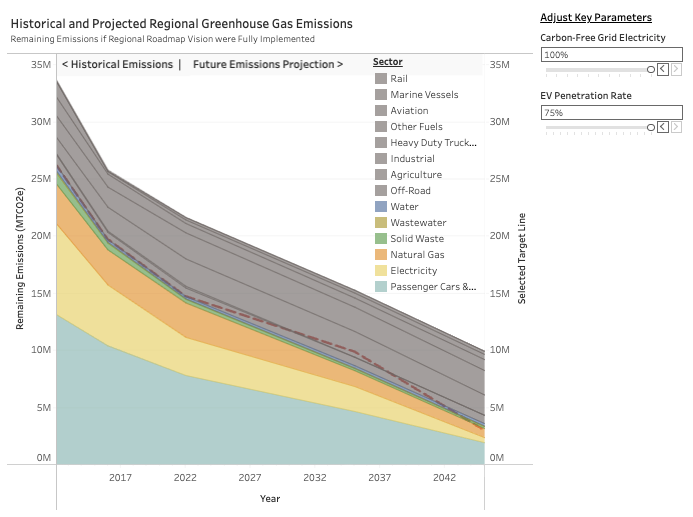
With a research grant from The San Diego Foundation, EPIC launched a new, first-of-its kind interactive website to visualize the San Diego region’s progress in reducing GHG emissions in the last decade and the potential for additional reductions from commitments in climate action plans. The site also identifies key barriers and opportunities for advancing long-term GHG emissions goals. The site is intended to help local jurisdiction and public agency sustainability staff, climate advocates, and community members understand current emissions, explore different GHG scenarios for potential future emissions trajectories based on policy implementation, and review policy opportunities and impacts.
The San Diego Regional Greenhouse Gas Emissions (GHG) Outlook and Gap Analysis allows users to view the progress our region has made since GHG emissions tracking began in 2012. It features interactive GHG Scenario Tools with emissions trajectories through 2050. The first tool illustrates the potential GHG reduction from full implementation of the SANDAG’s San Diego Regional Climate Roadmap. The second tool compares GHG reductions from the Roadmap to the sum of all local GHG reduction commitments in climate action plans in the San Diego region. Both tools account for the GHG reductions from currently enacted state laws and regulations and allow users to change key policy parameters, including EV adoption rate and supply of renewable electricity, to see the effect on regional emissions. The website also allows users to see local GHG reduction commitments from all climate action plans in the region, including the numeric goals for each. The newly launched site also shows emissions trends for major categories, including electricity, natural gas, on-road transportation, and solid waste. For each category, EPIC also summarizes the impact that federal and state policies might have on local climate policy implementation while highlighting key opportunities for high-emitting sectors to achieve long-term reduction goals. Each topic features a brief background and main takeaways, alongside full policy briefs with more details. Additionally, because many local Climate Action Plans have adopted net-zero GHG targets, EPIC developed a primer on carbon dioxide removal to explain what CDR is, current methodologies, and the role it plays in reaching net-zero goals.
About the Energy Policy Initiatives Center
The Energy Policy Initiatives Center (EPIC) is a nonprofit academic and research center of the University of San Diego School of Law that studies energy policy issues affecting the San Diego region and California. EPIC integrates research and analysis, law school study, and public education to help policymakers, regulators, and community stakeholders make informed decisions on energy matters. To learn more, please visit EPIC's website.
About the School of Law
Each year, USD Law educates approximately 800 Juris Doctor and graduate law students from throughout the United States and around the world. The law school is best known for its offerings in the areas of business and corporate law, constitutional law, intellectual property, international and comparative law, public interest law and taxation.
USD School of Law is one of the 88 law schools elected to the Order of the Coif, a national honor society for law school graduates. The law school’s faculty is a strong group of outstanding scholars and teachers with national and international reputations. The school is accredited by the American Bar Association and is a member of the Association of American Law Schools. Founded in 1954, the law school is part of the University of San Diego, a private, independent, Roman Catholic university chartered in 1949.